TV Size and Viewing Distance Calculator
Use the TV size and viewing distance calculator to estimate the best screen size for your sofa distance, then compare common 32-115 inch TV sizes with practical room-fit advice.
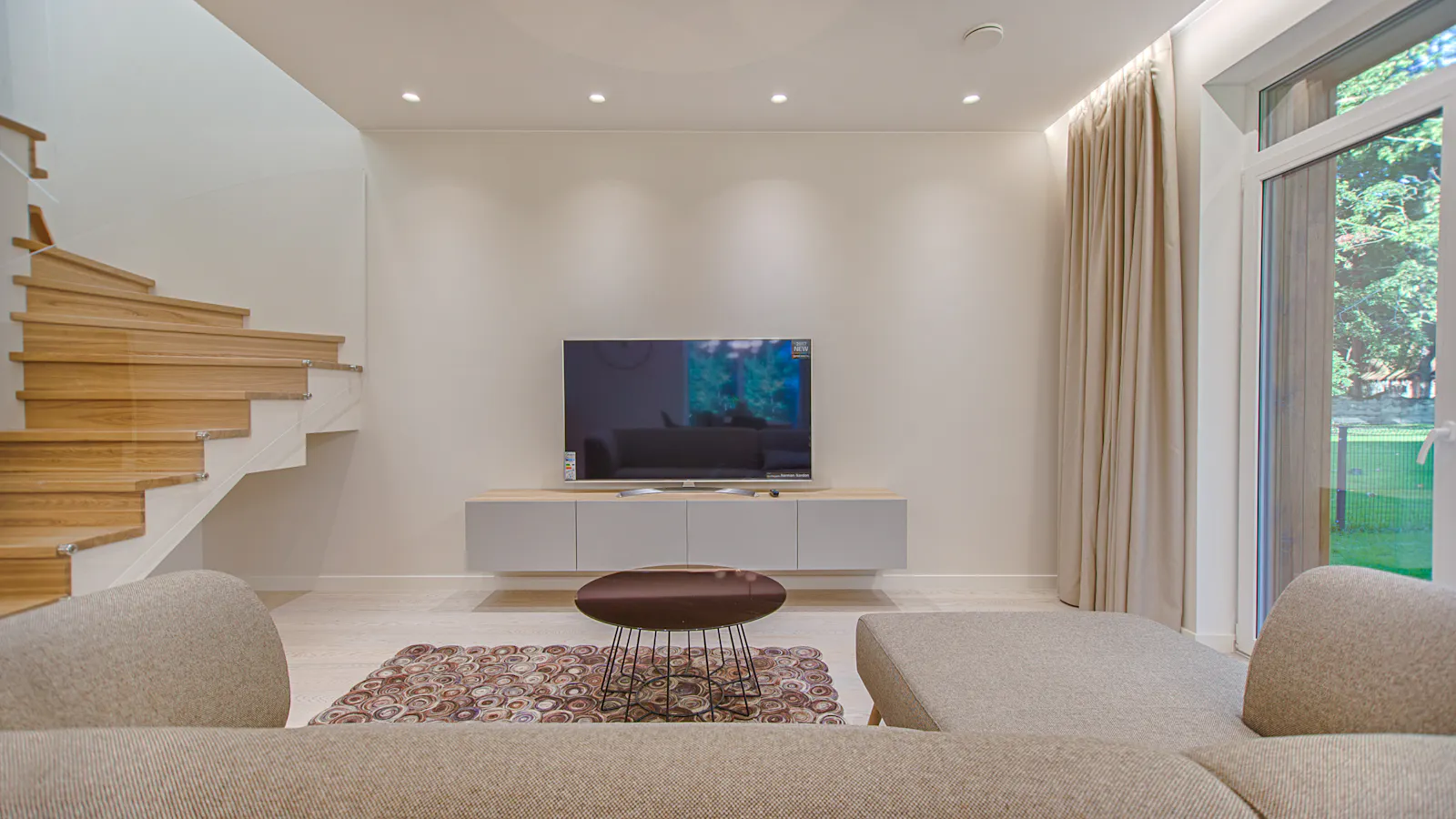
TV size and viewing distance calculator
Enter your sofa-to-screen distance to estimate a practical TV size range for mixed viewing and a larger cinematic setup.
Mixed-use size
64 in
Cinematic size
80 in
Safer range
56-77"
Nearest common sizes
Smaller
65 in
Suggested
75 in
Bigger
85 in
These are practical estimates for 16:9 TVs. Room layout, eyesight, source quality, and personal preference still matter.
Why viewing distance matters more than people think
A TV can feel oddly small or uncomfortably large even when the spec sheet says it should be right. The missing variable is almost always seating distance. Too far and the detail disappears. Too close and the screen starts to ask too much from your eyes and neck.
Quick answer: what TV size for your distance?
If you want a fast starting point, match your sofa distance to one or two common sizes rather than chasing an exact number. Most people end up happier choosing from the nearest real TV sizes available in stores.
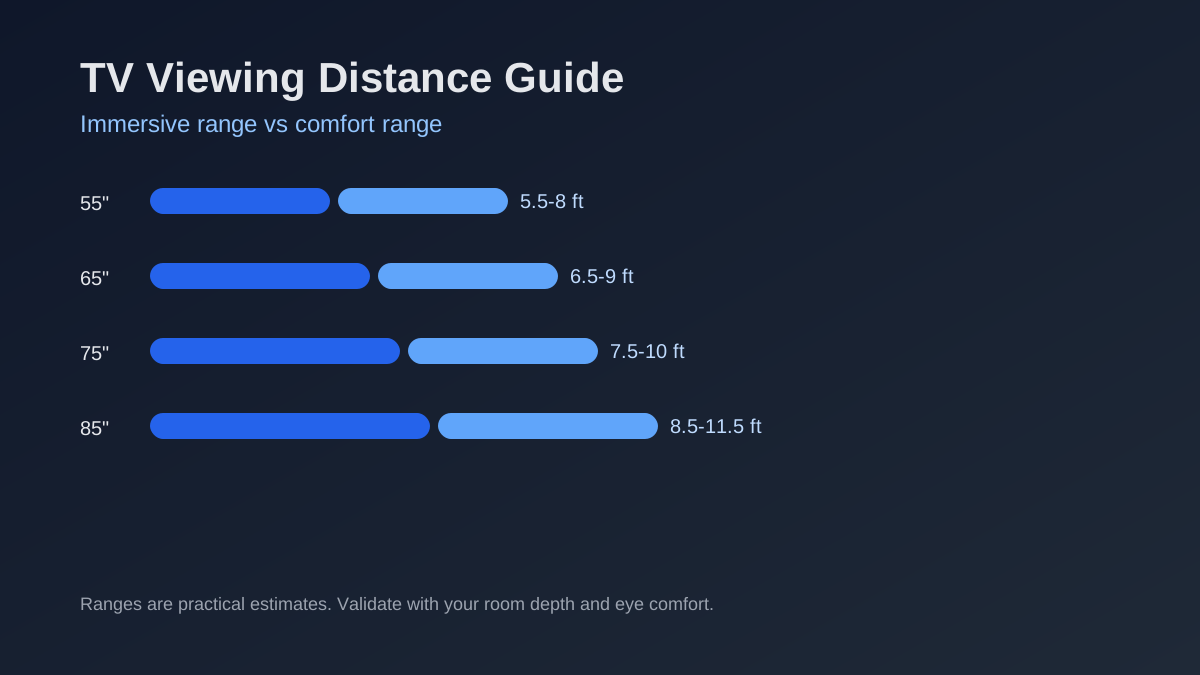
Common sofa distance and TV size picks
| Sofa distance | Safer pick | More immersive pick |
|---|---|---|
| 6 ft | 43-50 inch | 55 inch |
| 8 ft | 55-65 inch | 65-75 inch |
| 10 ft | 65-75 inch | 75-85 inch |
| 12 ft | 75-85 inch | 85-98 inch |
30-degree vs 40-degree field of view
A smaller field of view, around 30 degrees, feels relaxed for mixed viewing: news, sports, YouTube, and family TV. A larger field of view, around 40 degrees, feels more cinematic because the screen fills more of your vision.
Neither number is universally correct. If the room is shared, start closer to comfort. If the room is for movies and games, the immersive side can be the better target.
Does 4K change the right TV viewing distance?
At the same screen size and seating distance, 4K does not change the physical field of view. A 65-inch TV fills the same amount of your vision whether the signal is 1080p or 4K, so room fit and the 30-degree versus 40-degree choice still start with geometry.
Resolution changes how much fine detail survives when you sit close. A clean 4K source lets you move closer before individual pixels or softness become distracting, but it does not override comfort, eyesight, compression quality, or the way you use the room. Use field of view to choose the size, then use source quality to decide how close you can comfortably sit.
Recommended TV viewing distance chart
Use this chart when you already know the TV size and want a seating distance. The 30-degree column is relaxed for mixed use, 40 degrees is a cinema-style target, and 62 degrees is an aggressive immersive limit for people who like a very large image.
Recommended seating distance by TV size and field of view
| Screen size | Mixed use (30°) | Cinema (40°) | Immersive limit (62°) |
|---|---|---|---|
| 32 inch | 4'4" (1.32 m) | 3'2" (0.97 m) | 1'11" (0.59 m) |
| 40 inch | 5'5" (1.65 m) | 4'0" (1.22 m) | 2'5" (0.74 m) |
| 43 inch | 5'10" (1.78 m) | 4'3" (1.31 m) | 2'7" (0.79 m) |
| 48 inch | 6'6" (1.98 m) | 4'9" (1.46 m) | 2'11" (0.88 m) |
| 50 inch | 6'9" (2.07 m) | 5'0" (1.52 m) | 3'0" (0.92 m) |
| 55 inch | 7'5" (2.27 m) | 5'6" (1.67 m) | 3'4" (1.01 m) |
| 60 inch | 8'2" (2.48 m) | 6'0" (1.82 m) | 3'8" (1.11 m) |
| 65 inch | 8'10" (2.69 m) | 6'6" (1.98 m) | 3'11" (1.20 m) |
| 70 inch | 9'6" (2.89 m) | 7'0" (2.13 m) | 4'3" (1.29 m) |
| 75 inch | 10'2" (3.10 m) | 7'6" (2.28 m) | 4'6" (1.38 m) |
| 77 inch | 10'5" (3.18 m) | 7'8" (2.34 m) | 4'8" (1.42 m) |
| 83 inch | 11'3" (3.43 m) | 8'3" (2.52 m) | 5'0" (1.53 m) |
| 85 inch | 11'6" (3.51 m) | 8'6" (2.59 m) | 5'2" (1.57 m) |
| 98 inch | 13'3" (4.05 m) | 9'9" (2.98 m) | 5'11" (1.81 m) |
| 100 inch | 13'7" (4.13 m) | 10'0" (3.04 m) | 6'1" (1.84 m) |
| 110 inch | 14'11" (4.54 m) | 11'0" (3.35 m) | 6'8" (2.03 m) |
| 115 inch | 15'7" (4.75 m) | 11'6" (3.50 m) | 6'11" (2.12 m) |
Distances are approximate and use horizontal field of view for a 16:9 TV. Final comfort still depends on eyesight, content type, and room brightness.
Complete 16:9 TV size chart
Diagonal size is the number on the box, but width and height are what decide whether the TV fits your wall, cabinet, or elevator. The measurements below assume a standard 16:9 screen and do not include bezels or stands.
Approximate width, height, and area for common TV sizes
| Screen size | Approx. width | Approx. height | Screen area |
|---|---|---|---|
| 32 inch | 27.9 in / 70.8 cm | 15.7 in / 39.8 cm | 438 in2 / 0.282 m2 |
| 40 inch | 34.9 in / 88.6 cm | 19.6 in / 49.8 cm | 684 in2 / 0.441 m2 |
| 43 inch | 37.5 in / 95.2 cm | 21.1 in / 53.5 cm | 790 in2 / 0.510 m2 |
| 48 inch | 41.8 in / 106.3 cm | 23.5 in / 59.8 cm | 984 in2 / 0.635 m2 |
| 50 inch | 43.6 in / 110.7 cm | 24.5 in / 62.3 cm | 1068 in2 / 0.689 m2 |
| 55 inch | 47.9 in / 121.8 cm | 27.0 in / 68.5 cm | 1293 in2 / 0.834 m2 |
| 60 inch | 52.3 in / 132.8 cm | 29.4 in / 74.7 cm | 1538 in2 / 0.992 m2 |
| 65 inch | 56.7 in / 143.9 cm | 31.9 in / 80.9 cm | 1805 in2 / 1.165 m2 |
| 70 inch | 61.0 in / 155.0 cm | 34.3 in / 87.2 cm | 2094 in2 / 1.351 m2 |
| 75 inch | 65.4 in / 166.0 cm | 36.8 in / 93.4 cm | 2404 in2 / 1.551 m2 |
| 77 inch | 67.1 in / 170.5 cm | 37.8 in / 95.9 cm | 2533 in2 / 1.634 m2 |
| 83 inch | 72.3 in / 183.7 cm | 40.7 in / 103.4 cm | 2944 in2 / 1.899 m2 |
| 85 inch | 74.1 in / 188.2 cm | 41.7 in / 105.8 cm | 3087 in2 / 1.992 m2 |
| 98 inch | 85.4 in / 217.0 cm | 48.0 in / 122.0 cm | 4104 in2 / 2.648 m2 |
| 100 inch | 87.2 in / 221.4 cm | 49.0 in / 124.5 cm | 4273 in2 / 2.757 m2 |
| 110 inch | 95.9 in / 243.5 cm | 53.9 in / 137.0 cm | 5170 in2 / 3.336 m2 |
| 115 inch | 100.2 in / 254.6 cm | 56.4 in / 143.2 cm | 5651 in2 / 3.646 m2 |
Actual product dimensions vary by bezel, stand, speaker housing, and manufacturer rounding.
Room examples: bedroom, apartment, living room, theater
A bedroom TV usually benefits from restraint because people often watch from closer range and at lower brightness. Apartment living rooms often land around 55 or 65 inches. Larger family rooms can make 75 inches feel normal, while a theater-style room is where 85 inches and above starts to make sense.
- Bedroom: usually 43-55 inch unless the bed is far from the wall.
- Apartment living room: 55-65 inch is often the safest range.
- Large living room: 75-85 inch can feel more proportional.
Source quality still changes the answer
A large 4K TV can look excellent with high-quality streaming, Blu-ray, modern consoles, and sports broadcasts. The same size can be less forgiving with heavily compressed streams or low-resolution cable channels, especially if you sit close.
Quick decision checklist before you buy
Use this checklist to avoid buyer regret. Most sizing mistakes happen because people skip one of these simple checks.
- Measure sofa-to-screen distance first, then choose TV size.
- Check real TV width against wall and cabinet limits.
- Confirm common content type: sports, movies, gaming, or mixed.
Common mistakes to avoid
A common mistake is treating diagonal size as the only metric. Another is ignoring wall height and eye level, which can make a “correct” size still feel uncomfortable.
FAQ
How far should I sit from a 65-inch TV?
For many living rooms, somewhere around 6.5-9 feet works well, and a lot of people end up happiest closer to the middle of that range. If the room is shared and used casually, leaning a little farther back often feels more relaxed.
Is 75-inch too big for a small room?
Not always. If your seating distance is roughly 8-10 feet and wall width is sufficient, 75-inch can still work well.
Should I prioritize immersion or comfort?
If you watch mostly movies, lean immersive. For mixed family viewing and long sessions, comfort distance is usually the better default.